006. Are we the baddies?
Some thoughts on internalised misogyny and the visceral horrors of introspection, from a white, middle-class woman*
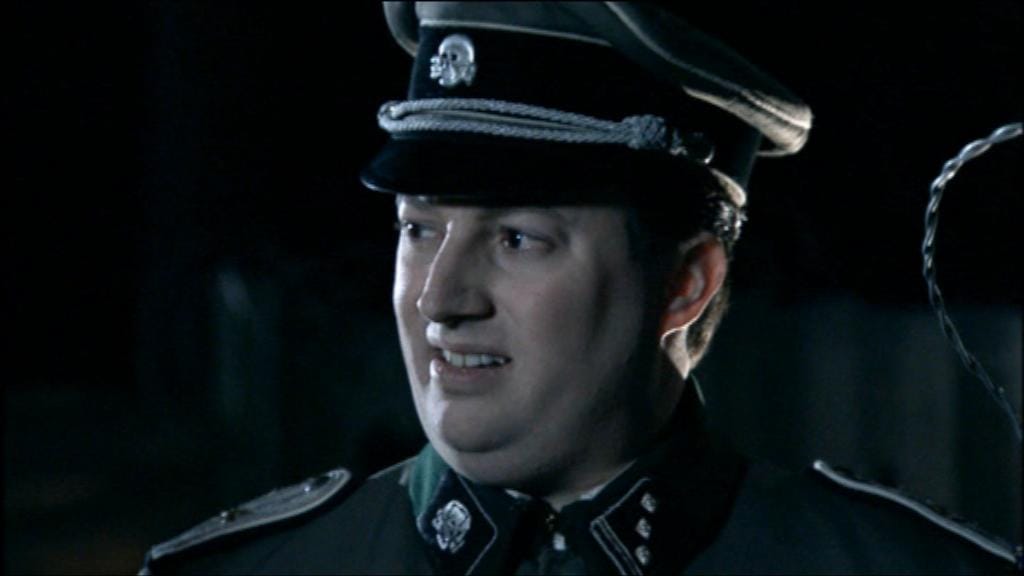
Lately, I find myself looking at people in power and thinking wistfully of the much-memed Mitchell & Webb sketch, “…are we the baddies?”
Despite all indications that yes, indeed, that is very much the case, I can’t see Jo, Hadley, Janice et al. reaching that conclusion any time soon. It appears they are either allergic to, or incapable of, the level of introspection required. Despite now eagerly lining up to cheer for a prolific sex offender and career criminal, it would be too painful, too embarrassing or too injurious to their carefully crafted self image, to look too closely at the hate they’ve chosen to peddle and realise what a foul mess they’ve created.
It seems to me that many self-proclaimed Adult Human Females (ew) are so busy looking for scapegoats for the unpalatable situation in which they find themselves, they can’t - or won’t - recognise that the iteration of feminism to which they subscribe is unutterably flat, pedestrian and restrictive. Tim Snyder, in On Tyranny: Twenty Lessons from the Twentieth Century, exhorts us, “Do not obey in advance”. Yet, this is exactly what anti-trans “feminists” are doing, in large part due to a failure or refusal to admit their own participation in upholding patriarchal societal structures.
At its most simple level, being feminist is about striving for equality for women. It turns out that many people never progress beyond this level of conceptual engagement. Without grasping the ideas of privilege and intersectionality, the “feminist” is necessarily stuck at the first step, unable to see that they may, in fact, be significantly better off than others due to their class, income, gender presentation, compliance with Western beauty standards, ability to pass through the world without accommodations for health/disability and so on.
I remember Matt Haig expressing his outrage on Twitter, back in the day, that he should be considered to have privilege. He had not been to private school, he experienced mental ill health, he was losing his hair… Whether intentional or not, this response demonstrates perfectly an unwillingness to engage with what is actually a very useful framework because a particular term, privilege, rankles with one’s self image. Specifically, he was conflating/confusing “being privileged”, a very British idea born of long-held class resentment, with “having privilege”, a framework for understanding systemic prejudice originating in critical race theory.
In the UK, “privilege” has historically been associated with royalty and aristocracy, the uppermost upper class. We’re talking Brideshead Revisited, stately home, Eton, an army of cap-doffing, curtsying servants, the lot. When that’s at one end of the scale, in your world view, everything else looks like peanuts in comparison and it does still persist to this day: just look at some of the buffoons who make it through the public (not state) school system and into positions of power, utterly convinced of their own fitness to lead despite the conspicuous dearth of qualifications. However, the existence of an extreme example does not mean everyone else is the same. We’re demonstrably not. Nor is it a sliding scale; it’s more like a web or matrix and the more boxes you are able to tick, or not, the trickier or easier your life will tend to be.
Like (/admit) it or not, we are living in a society that privileges those who are, in no particular order…
- Male
- White
- Heterosexual
- Cis (gender aligns with the sex assigned at birth)
- Slim and ‘attractive’ (according to Western beauty standards)
- Physically able
- Neurotypical
- Mentally well
- Upper or middle class
- Not “too old”
The more of those attributes you have, the more privilege/societal capital you have. These things can change and shift over time, and your capital with them, and, because this is only a framework, operating at population level, there are always exceptions. When laid out like this, the system appears pretty straightforward. Also, as someone who has always, unfailingly, been all too aware of their shortcomings as well as painfully alert to the feelings of others, I found this less of a confronting idea than perhaps some might.
The difficulty comes with the realisation that, for years, many feminists have defined men as the enemy and themselves as virtuous champions and/or victims. This deeply embedded binary approach leaves no room for nuance and no need to interrogate. It’s simple, easy but also arrogant and deeply limiting.
Hashtag not all men: ha, what a cliché! But, the reason it’s a cliché is because it’s so obviously true that it doesn’t need to be said. When men send up the cry, we roll our eyes because it’s unnecessary, not because it’s untrue — don’t we? I’ve come to realise that some “feminists” really do think it’s all men, or at least find that easier to think. That way, it excuses them from any culpability; it’s the men! All the men!
And so, with the embrace of such a flattened world and self-view, it’s so much more straightforward to define everything else in opposition to oneself. If you really want equality for women, you must accept that all women are not already equal within the group and that there are infinite ways in which to be a woman: to insist on definition and uniformity is to enforce patriarchy voluntarily, to be a handmaiden. Tell me you didn’t understand The Handmaid’s Tale without telling me you didn’t understand The Handmaid’s Tale…
It has been argued that true equality means the opportunity to be as bad as a man and yeah, I can see it. In art and literature, it would be bizarre to insist that female characters only exhibit “good” behaviours. Two lately much-celebrated villains, Maleficent and Ursula, are pretty fabulous, they’re taking back their power — except, the people who *actually* come off worst are vulnerable, disempowered young people who want to make their own choices in life, not the oppressors who put in place the conditions for their exclusion from society. And, by targeting vulnerable people who don’t conform, these characters, like their real-life counterparts, give the lie to the ‘with us or against us’ binary. They are not trailblazing rebels, they’re upholding the very barriers they purport to despise.
The other huge issue with “with us or against us” is the sense that rights are a finite resource, being hoarded by those nasty selfish men and, perhaps, granted in exchange for compliance or good behaviour. Luckily, rights are not pie: there is no ‘last slice’. Every human has rights; they are innate, they cannot be used up, shared up or taken away. What they can be is ignored. And they are, frequently, and usually depending on how many aspects of privilege someone can claim and whether it is expensive or expedient in a capitalist system.
That is clearly wrong and yet it’s happening more and more, especially as “feminists” become the World Police of What Is A Woman. Where people don’t conform to the specific elements of womanhood tacitly agreed to be necessary in order to “count”, they immediately fall under suspicion. They are other.
Cis men fall into this category by default, unless they’re able to prove themselves a knight in shining armour by decrying a common enemy. Trans men are “confusing”: being a woman is at once awful but also the only way to be acceptable, as a heroic victim. So, when everything is viewed through the for/against lens, it’s deeply conflicting to see someone who appears to have cast off the yoke of femaleness in a patriarchy (yay?!) and “joined” the perceived enemy. Are they a model or a coward?
Aligned with the embrace of victimhood, I can’t help but think a level of anti-trans vitriol, especially when it comes to trans women, is rooted in envy. Many “feminists” feel, more or less consciously, that they have earned their identity and their right to comment through suffering. They see that pain as an essential component of womanhood, instead of the oppressive result of living in a patriarchal society. It has become something inevitable instead of something to be resisted and fought back against, cast off indeed. It’s not even that old chestnut, “I was smacked and it never did me any harm”. It’s “I was smacked and it did me demonstrable long-term psychological damage, and yet I declare you must endure the same in order to be worthy”. What on earth?!
Despite the wealth of evidence showing that it is incredibly, horribly traumatic to go through life presenting as the gender that does not reflect your truth, and facing different but just as hurtful abuse if you do transition, that group of “feminists” will insist that, while you may have suffered, it wasn’t the right suffering. The “right” suffering is attached to specific biological processes and rights of passage, harassment and abuses by men and the problems inherent in patriarchy.
And so, things start coming back around. A loud, vocal section of a movement supposedly fighting for equality have been shocked by the realisation they may have benefited from some of the systems in which they live, despite the real pain and difficulty they have experienced, and so, in an effort to reassure themselves, right the ship and identify the true enemy, they fall back on the same biological essentialism and aesthetic rules that they started out trying to tear down.
These are (some of) the same people who burned bras, who celebrated the availability of over-the-counter contraception, who fought to participate and be rewarded in the political process, the workplace, the arts and the sports field despite the fallacious objections of men. Now, not only will they not extend their support to other, more vulnerable groups, they actively persecute trans women in particular who they feel are “claiming” womanhood without earning it, or, because womanhood is pain, must have a nefarious ulterior motive. Plus, their all-consuming suspicions also mean that adult cis women are being accosted going into toilets and young girls are being asked to “prove” they are female at sports matches because they have short hair.
I find this situation both horrifying and deeply tragic, because it is so completely unnecessary. This is an imaginary war where there can be no victor other than patriarchy, only innocent casualties, destroyed reputations and a group of women who have shown themselves unable to distinguish between justified fear and anger at an oppressive system and their discomfort at having to recognise and reckon with their own complicity.
Which brings us back to Jo, Hadley, Janice and Donald. Can they really, truly, mean what they say: that Trump is a feminist hero because he’s announcing measures that aim to make life untenable for trans people? How can persecution of a group that is, by any objective measure, one of the most vulnerable, be part of a fight against oppression? It’s clearly nonsense. Rights, as we have established, are not finite; denying the rights of this group does not mean there are now more for everyone else. In fact, as we’ve seen, it’s an indication of what’s in store for more of the population.
It looks very much as if trans people are the proverbial canary in the coal mine (sadly, looks like we’ll be getting more of those too). The classic fascist playbook goes, start with the easiest target: criticise, demonise, brutalise and see how much those not targeted will tolerate. Will they swallow the lie that “worse for those people means better for me”? Maybe they’ll even join in, despite being against their best interests, because at a time where it feels like everything is against you, it’s easier to pretend that it’s true.
None of this is new. In fact, it’s as old as human nature. There’s literally a poem about it. And the sense that trans persecution is the thin end of the wedge in terms of the number of people involved makes it no less horrendous. I’d argue it makes it much worse. There are so many issues in the world that are actual, legitimate problems; that trans people, especially trans women, are being scapegoated in this way shows how much those in power want to cause a distraction and just how unwilling a raft of women are to engage in any form of introspection.
And yet, here we are. I’d like to think that at least some of those “feminists” are reachable, that they’ll look over, see they’re snuggled up with the pussy grabber in chief and start to reevaluate their choices. Some are clearly too far down the rabbit hole, except we’re more in the region of burrows clogged with corpses a la Watership Down than a moralising jaunt through wonderland.
I do want to end, though, with an offer of hope, particularly aimed at people like me who have more privilege in that checklist:
A better way is possible, if you choose it. The society we inhabit operates on a matrix of privilege according to sex, race, class, ableism and so on, but we can agree that this system is bullshit. Do not obey in advance, or at all! Choose not just life but the life you want and deserve, and work for a world in which everyone is afforded the opportunity to do so as well.
People really are stronger working together in solidarity. However, to be able to do that, we must start by looking inside ourselves and recognising the point from which we start, to build forwards from there. It’s not possible to work united with comrades when we’re harbouring resentment towards them for their accurate - but embarrassing? - recognition of our privilege. If you have an advantage, use it to the benefit of everyone. After all, “I am not free while any woman is unfree, even when her shackles are very different to my own” (Audre Lorde).